Le Chambon-sur-Lignon
I love a road trip. This year, I convinced my family to explore a part of France that we had never visited before. We drove toward Lyon, then two hours Southwest from the city we stopped in Le Chambon-sur-Lignon. It is a tiny village nestled on Le Plateau, a peaceful highland region about 3000 feet (1000m) above sea level, surrounded by beautiful green forests in France’s massif central region.
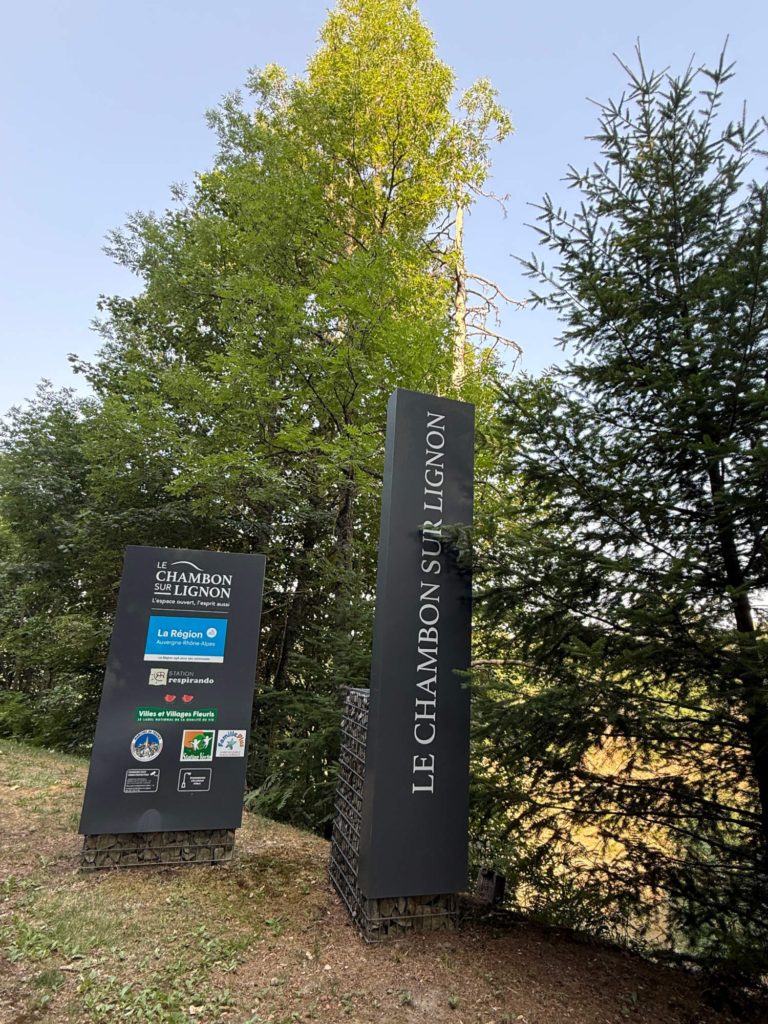
In 1990, the village was honored by Yad Vashem as Righteous Among the Nations. Usually, Yad Vashem—Israel’s official memorial and world center for Holocaust commemoration, documentation, research, and education—recognizes individuals who risked their lives to save Jews during the Second World War. In this extraordinary case the honor was bestowed on an entire village. The courageous people of Le Chambon-sur-Lignon and Le Plateau helped save more than 2,500 Jews (some estimate up to 5,000) between 1942 and 1944, when the region was liberated.
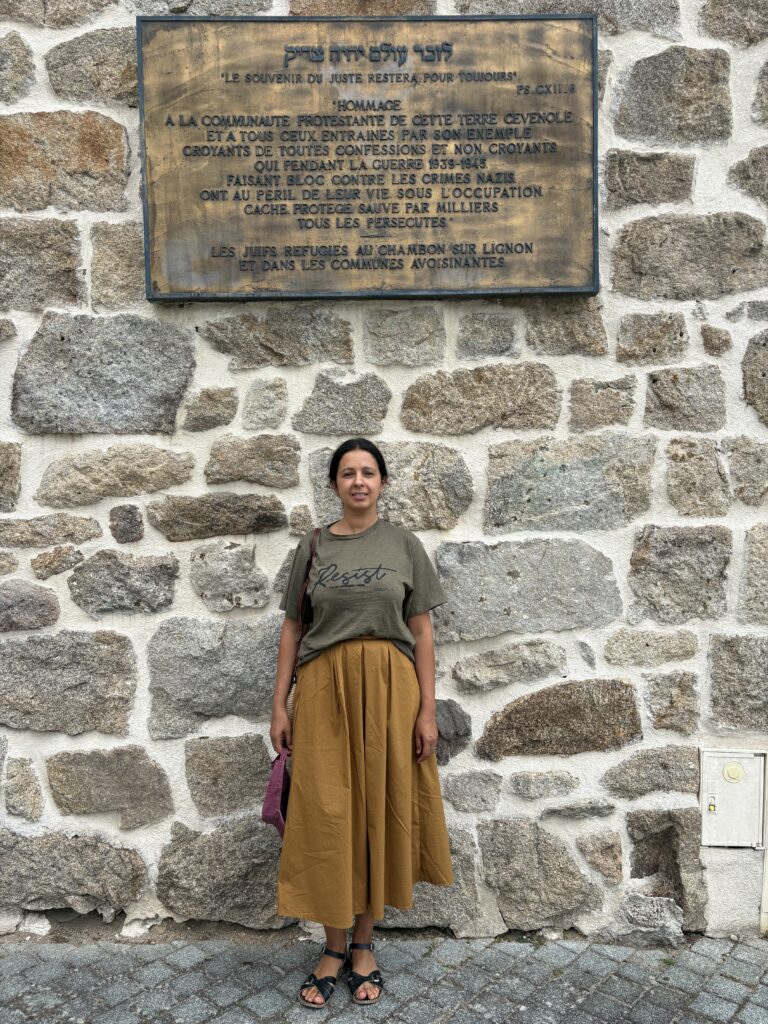
The title Righteous Among the Nations is awarded by Yad Vashem to gentiles who risked their lives to save Jews during the Second World War without requiring financial compensation and who’s actions are substantiated by three witnesses or more. In the case of Le Chambon-sur-Lignon and Le Plateau, 89 individuals have been officially recognized as Righteous Among the Nations. The reality is, many inhabitants believed they did the right thing and didn’t deserve public recognition. It is certain that the actual number of righteous is much higher.
While driving from Paris to Le Chambon-sur-Lignon (6 hours) we discussed how we have never been to any other place in Europe where so many people were saved.
Why is place so different from any other place?
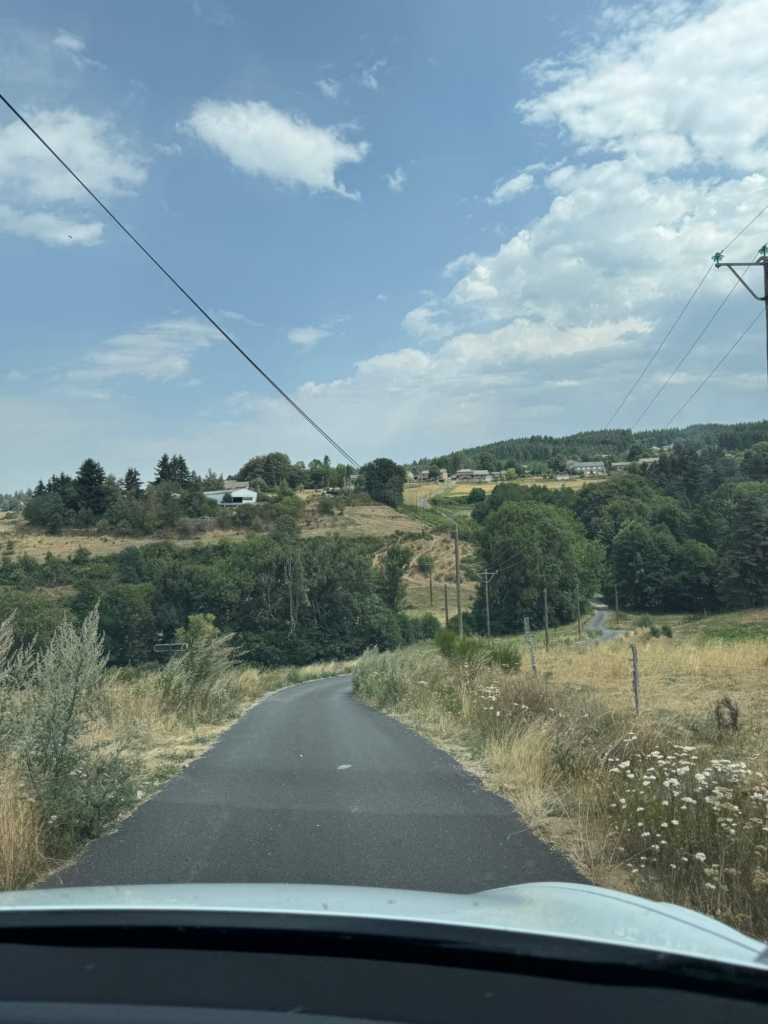
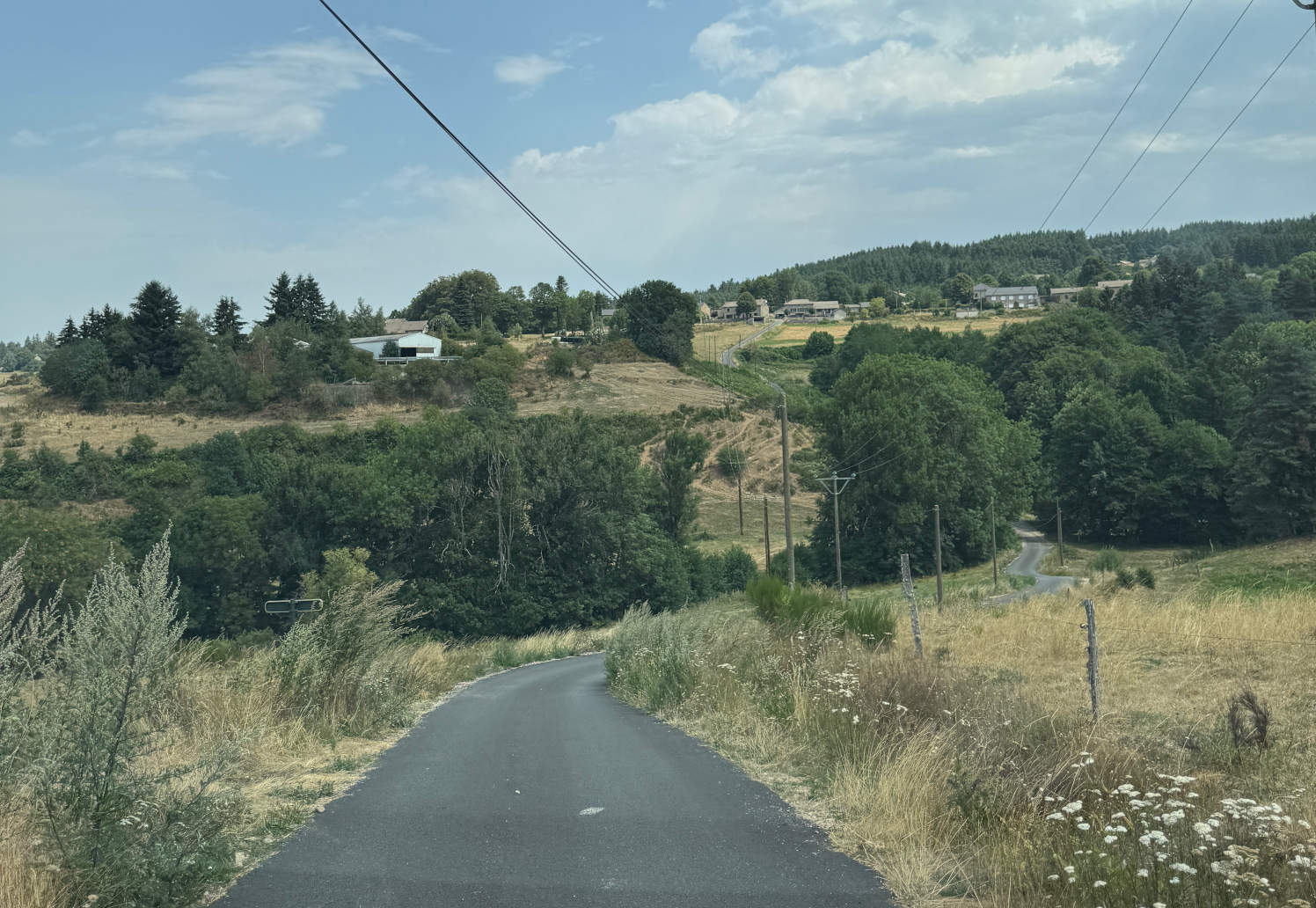
As we got closer and closer to le Chambon-sur-Lignon, I noticed how isolated it was from any big cities. Clermont Ferrand is 62 miles (100km) away and Lyon is 81 miles (130km) away. The roads leading to the village wind through the mountains for miles, with steep, twisting turns. Cars in 2026 have little difficulty navigating these roads. However, automobiles in the 1940s were far less sophisticated, and the roads themselves would have been much more primitive and poorly maintained. (The road we took was recently repaved for the Tour de France). Reaching the village by car would have been challenging for outsiders, especially those without a specific reason to travel there.
The views are breathtaking, and the air is fresh. For this reason, in the early twentieth century, charitable organizations such as the Children’s Mountain Association were established to provide children from working-class families in nearby cities with an opportunity to spend their summer holidays on local farms. Children benefited from nutritious food, fresh air, and farmers received a stipend from the association. (Similar associations existed in other regions of France (e.g., Isère, Vosges, and Auvergne). Finally, in 1936, Léon Blum (kvar Blum!) introduced the law establishing paid annual leave. As a result, some farming families in Le Plateau adapted their farms to accommodate not only a few children during the summer, but to provide summer rentals for entire families. Because the roads were so difficult to navigate, a railway was built to connect the isolated communities of Le Plateau with the wider region, including Lyon and Saint Etienne. This railway was built with smaller tracks and not compatible with the main French rail network. The trains carried mail, supplies, and the children who came to Le Plateau through the Children’s Mountain Association. During the 1940s, it also transported refugees seeking safety.
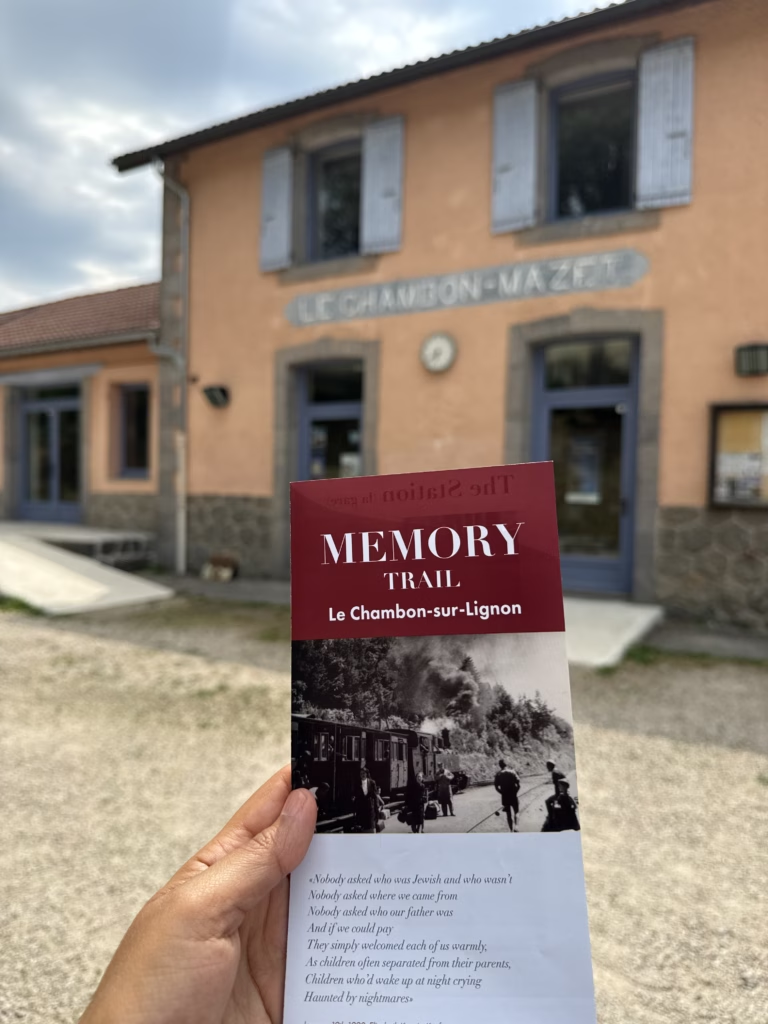
Together, the region’s isolated geography and its ability to accommodate visitors made Le Plateau an ideal refuge for people fleeing persecution during the Second World War.
However, there was one more important reason why so many Jews were saved in this region. More than 40% of the population of Le Plateau was Protestant. Having endured centuries of persecution under Catholic monarchs, they understood what it meant to be targeted for their beliefs. Their own history of suffering and massacres inspired many of them to show compassion to those facing persecution during the Second World War by welcoming them into their homes and protecting them.
After the French police arrested 13,152 Jews, including 4,115 children, during the Vel’ d’Hiv Roundup in July 1942, the pastor of Le Chambon-sur-Lignon, André Trocmé, delivered a sermon urging his congregation to “love your neighbor as yourself.” His message strengthened the village’s commitment to accept Jewish families and children. Local farmers welcomed children into their homes and adapted their summer guest accommodation to house Jewish refugees free of charge. For many of those in hiding, life remained as normal as possible.
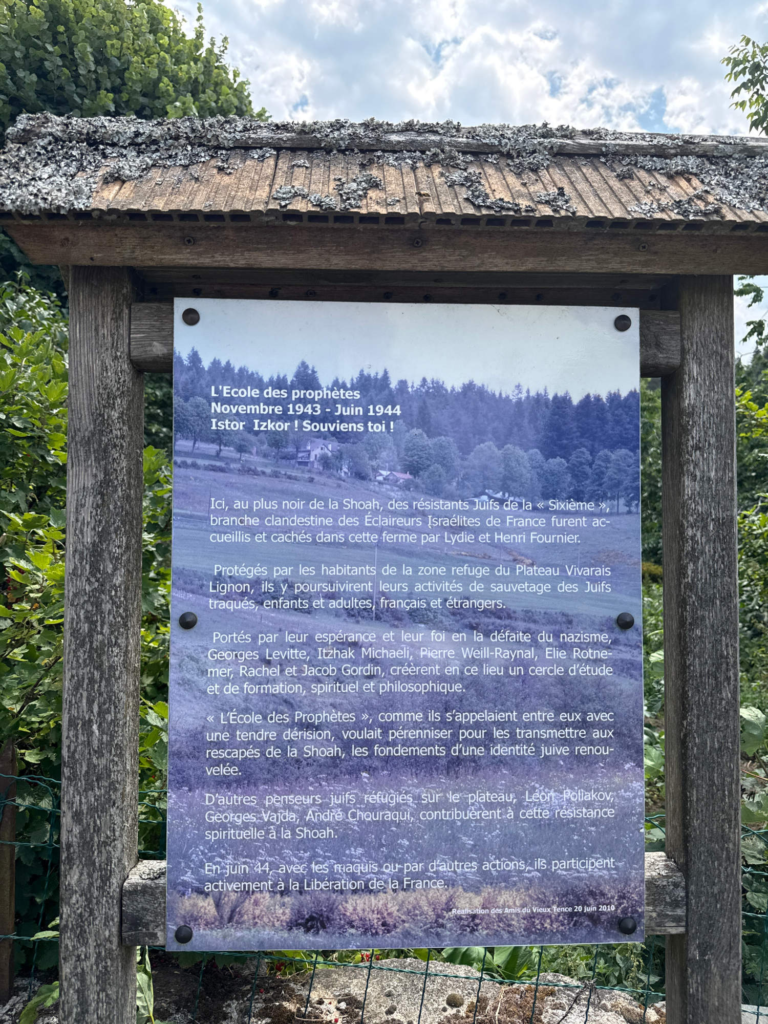
I could end the story there, but that would be unfair to the remarkable young Jewish thinkers who didn’t just want to save these children but to continue to educate children and preserve their Jewish identity. This is how the Jewish School of the Prophets, a clandestine center of Jewish learning and reflection was established in 1943. André Chouraqui, Jacob Gordin, Georges Vajda, Georges Levitte, and members of the Éclaireurs Israélites de France (EIF – the Jewish Scouts of France) lived in the hamlet of Istor. Their goal was to preserve the children’s Jewishness by teaching them the Hebrew Bible, Jewish history, the Hebrew language, and Jewish culture. They were not only helping children survive the war but also preparing the next generation to rebuild Jewish life in France after its end.
In September 1944, the region was liberated. Soon afterwards, the refugee families began to leave, and life on the farms gradually returned to normal. In 1945, the first EIF (Éclaireurs Israélites de France), the Jewish Scouts of France, returned to camp in the region.
For some of the children, however, returning to visit the families who had saved them was too painful. Only after leaving Le Plateau many of them learned about the horrors of the Holocaust. It was not until decades later that many survivors returned to thank the families who had protected them, and it was then that the effort to honor these rescuers truly began.
In 1971, Pastor André Trocmé was recognized by Yad Vashem as Righteous Among the Nations. By 1990, more than 80 residents of Le Plateau had received the same honor. In recognition of their collective courage and compassion, the village of Le Chambon-sur-Lignon was itself honored by Yad Vashem as Righteous Among the Nations.
When we arrived in the village, we parked our car and walked to the railway station that had served during the Second World War before closing to passenger service in 1968. Today, a tourist train operates from the station, yet there is not a single sign mentioning the wartime rescue. The village’s main attractions remain its beautiful scenery and fresh air, much as before the war.
We then stopped at the church where André Trocmé delivered his famous sermon, we found a small plaque displaying two passages from the Bible: Matthew 22:37–39, “Love your neighbor as yourself,” and Leviticus 19:33–34:
“When a foreigner resides among you in your land, do not mistreat them. The foreigner residing among you must be treated as your native-born. Love them as yourself, for you were foreigners in Egypt. I am the Lord your God.”
Across the road from the church stands the memorial that tells the story of the thousands of Jews rescued in this region during the Second World War. One of the commemorative plaques bears the words of Psalm 112:6 “For he shall never be shaken; the righteous shall be remembered forever.”
Another reads:
“In memory of the Protestant community and of all those inspired by its example—believers of every faith and non-believers—who, during the war of 1939–1945, united against Nazi crimes and, at the risk of their own lives, hid, protected, and saved by the thousands all those who were persecuted.”
And that is all. Life in the village goes on quietly, just as it always has.
As we drove away, I told my children why we had come to Le Chambon-sur-Lignon. I wanted them to know that, even in the darkest of times, there are good, brave, and compassionate people. It is now their generation’s responsibility to keep this story alive.
Our lost stop was to find the School of the Prophets. There is no real address, just the name of a path – Istor. We missed the path and had to drive back looking for the hamlet. Today someone still lives there. The hamlet was closed. An old dog greeted us and asked for cuddles. A board explaining the activities of the school stands next to a large bush of redcurrants overlooking a spectacular valley. It’s so quiet and peaceful there. This story is not only about survival but also of the resilience of Jews to continue and study Jewish texts and prepare the future strong Jewish leaders.