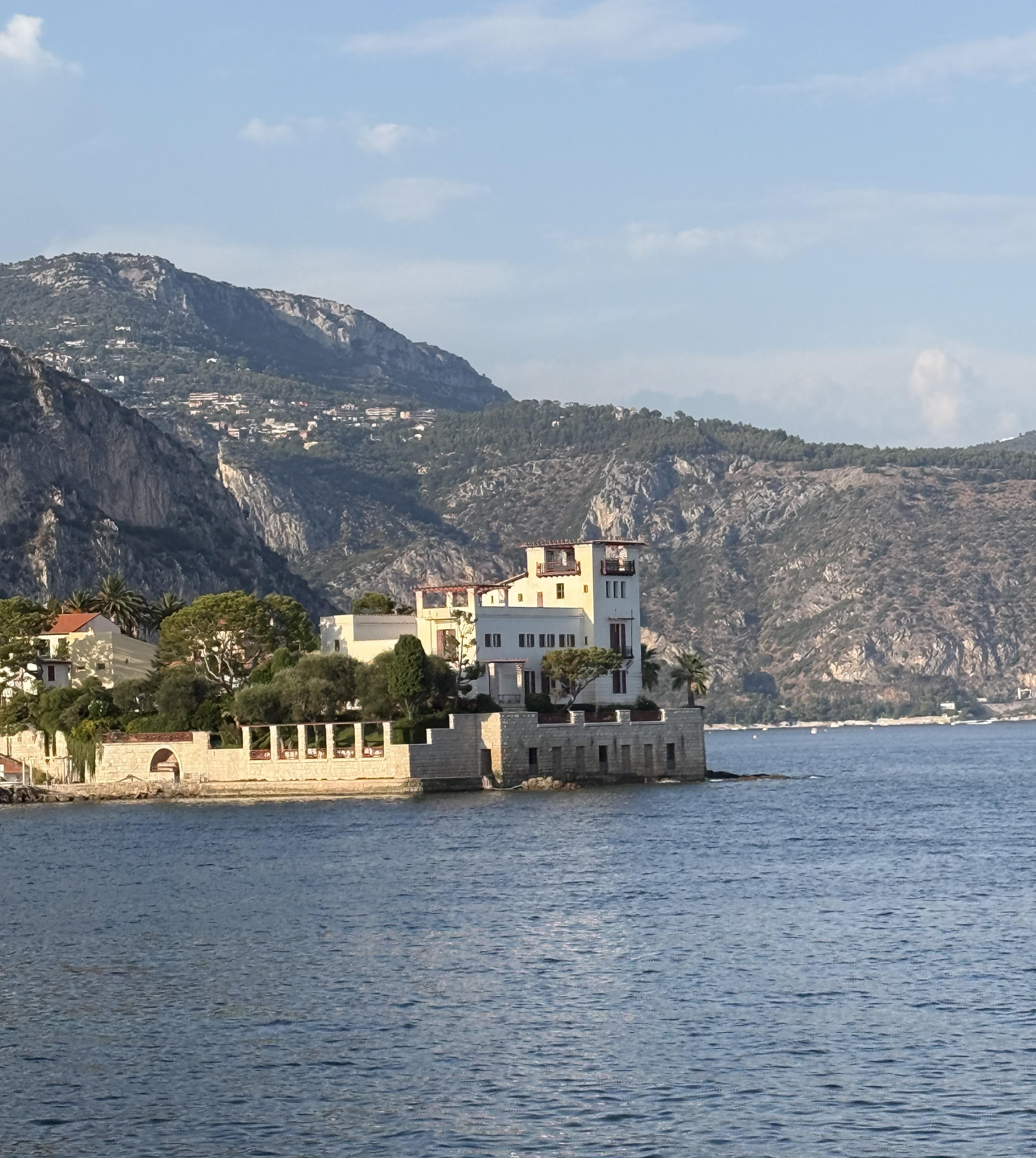
Some houses are simply family homes. Others become part of a country’s cultural patrimony. Villa Kérylos, perched on the rocky shore of the French Riviera, belongs to the latter.
Ever since I visited Villa Kérylos last summer, I haven’t been able to stop thinking about how the Reinach family and their extraordinary legacy are relatively unknown today compared to the magnificent villa they built.
This essay is my attempt to bring their story back into view and to look at their remarkable contributions to France.
The Reinach was a Jewish family who came to France from Frankfurt in the 1840s, when Hermann-Joseph Reinach settled in Paris and established himself as a banker. His sons were born and raised in France. Joseph, Salomon and Théodore, became known as “the know-it-all brothers” due to their remarkable breadth of knowledge and achievements across law, politics, archaeology, history, music, and classical studies. Joseph was a prominent lawyer, Salomon became a distinguished historian, and Théodore, the youngest, devoted his life to archaeology, Hellenism and Jewish history. It is Théodore’s magnificent villa that I visited last summer, Villa Kérylos on the French Riviera.
At the beginning of the twentieth century, the French Riviera had become a fashionable winter destination for Europe’s wealthy and cosmopolitan elite, who came there to build magnificent Belle Époque second residences. Its Mediterranean climate offered sunshine, sea air, and an escape from the harsh winters of northern Europe.
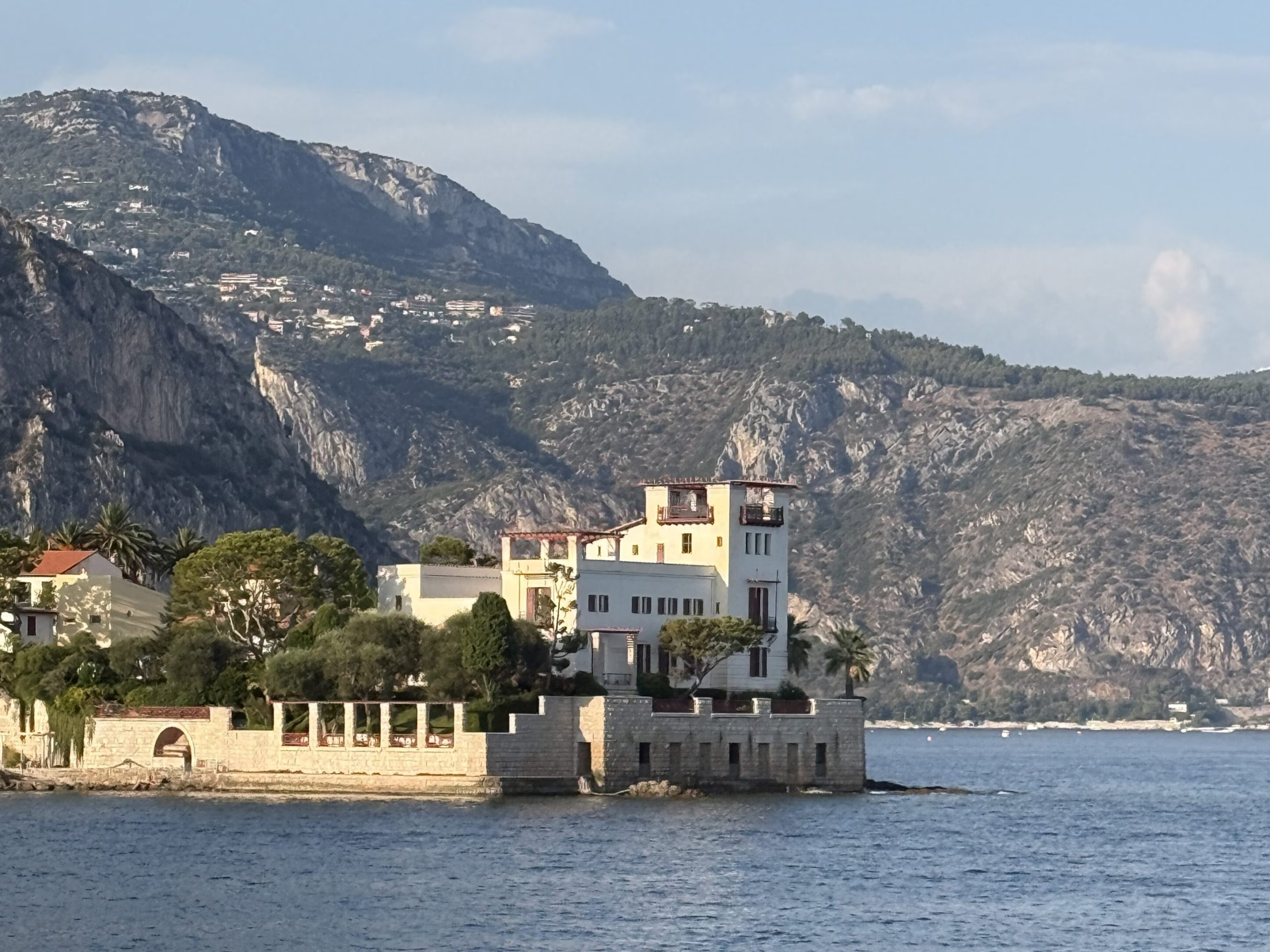
Rather than building another Belle Époque villa, Théodore Reinach chose a rocky site beside the sea and set out to create a Greek house. His fascination with the Hellenistic world was deepened by the archaeological discoveries on Delos. The island where Jewish community had lived alongside Greeks and other Mediterranean peoples from the 2nd century BCE.
More than two thousand years later, two Jewish men with a shared fascination for the ancient world would cross paths in Paris. Théodore Reinach was introduced to the architect Emmanuel Pontremoli at the 1900 Universal Exposition, an encounter that would lead to a remarkable partnership. Villa Kérylos was the extraordinary result of that collaboration.
Built between 1902 and 1908 this villa is a modern reinterpretation of a Hellenistic house. It is an intellectual experiment imaging what would an ancient Greek architect have built if he had possessed the technology of 1900. The house was designed around a peristyle, with white Carrara marble columns enclosing an interior courtyard. Rooms open toward the peristyle, gardens and sea. The sequence of spaces produces carefully framed views: one room reveals columns, another the Mediterranean Sea, another the surrounding gardens. Yet the house is unmistakably twentieth century. Large windows flood the interior with light. Electricity illuminates rooms that imitate antiquity. Modern plumbing and heating are discretely integrated into a house that appears, at first glance, to have escaped from ancient Greece. The French Ministry of Culture describes it as an ideal reconstruction of a Hellenistic Greek house adapted to modern functionality and electric lighting.
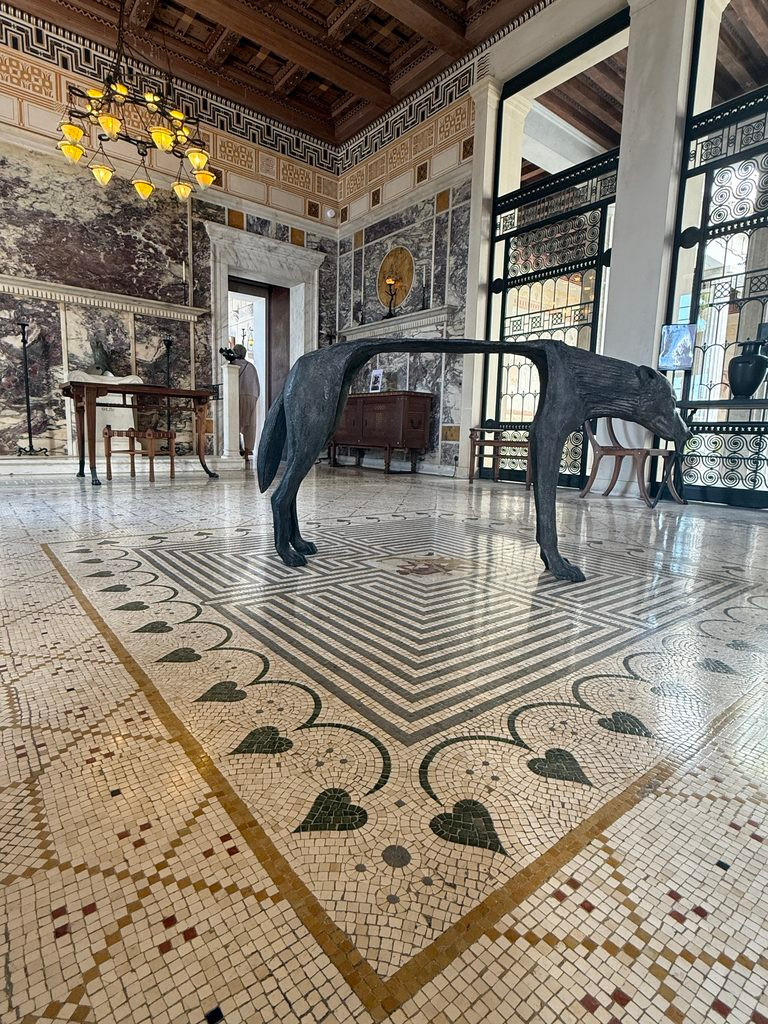
Theodore Reinach did not intend villa Kérylos to feel like a museum. The rooms and furnishings were designed for family living rather than assembled as museum exhibits. Like the ancient greeks, the Reinach family spent their time working, eating, playing, receiving guests and performing the ordinary rituals of daily life.
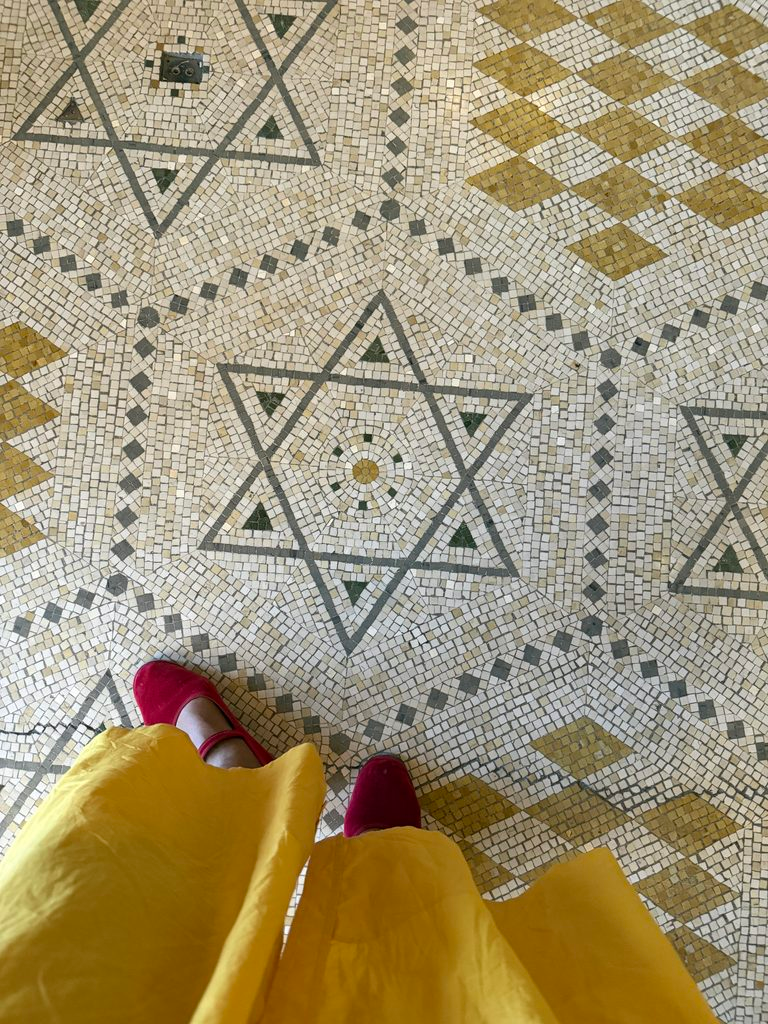
I wonder did Théodore Reinach seek to recreate on the French Riviera a Hellenistic world that had itself been home to a rich Jewish family in 2BCE, in the 1900s? The great excavations of the late nineteenth and early twentieth centuries revealed ancient cities not as fragments of isolated monuments but as complete environments. Walking through Kérylos, noticing the Stars of David floor mosaic among the elaborate Greek-inspired interiors, I found myself thinking about these two cultures, Jewish and Hellenistic, and I couldn’t help imagining a Jewish scholar and a Jewish architect creating a house where these layers of history would meet again.
In this villa, Theodore Reinach encompassed his Jewish identity and his fascination with Greece. He studied the Greek-speaking Jewish historian Flavius Josephus, wrote about the history of Israel, studied Jewish coins, and at the same time devoted himself passionately to Greek archaeology and mythology. Villa Kérylos holds a distinctive place in French cultural heritage, bringing together archaeology, architecture, scholarship, and civic life while reflecting the Reinach’s profound contribution to France’s intellectual and cultural patrimony.
Théodore Reinach named his villa Kérylos, an ancient Greek word associated with a swallow of good omen. Yet the history of the Reinach family carries a darker irony: despite being deeply woven into the intellectual and civic life of France, their descendants would ultimately be persecuted simply because they were Jewish. Théodore’s son Julien Reinach, was arrested at Villa Kérylos in September 1943 and sent to Drancy. On May 3, 1944, he was deported from Drancy to Bergen-Belsen, where fortunately he survived the war. Theodore’s other son Léon, his wife Béatrice de Camondo, and their children Fanny and Bertrand were deported and murdered at Auschwitz between 1943 and 1944. The family’s cultural possessions, books and archives were looted during the Occupation, some of which were never recovered.
Villa Kérylos survived, becoming a monument to ancient Greece.
Today, the villa is advertised as an “Odyssey into Ancient Greece: an immersion into ancient Greece, without leaving the French Riviera” built by an art patron Theodore Reinach. The Grand Sud magazine proposes “sunset or night-time visits (of this Institue de France property) reveal the villa in a different light, as the glow filters through the columns and revive the spirit of ancient civilization….
I wish for Villa Kerylos to be a remarkable place where the Reinach’ intellectual legacy, their contribution to France, and the devastating history of their descendants can still be remembered.